


How to Reply to Guest Reviews: Response Structures for Positive and Negative Reviews
Do you freeze every time you face the reply box? Set up a basic framework for positive and negative reviews, and the time and stress of writing replies drop sharply.
2026.11.09
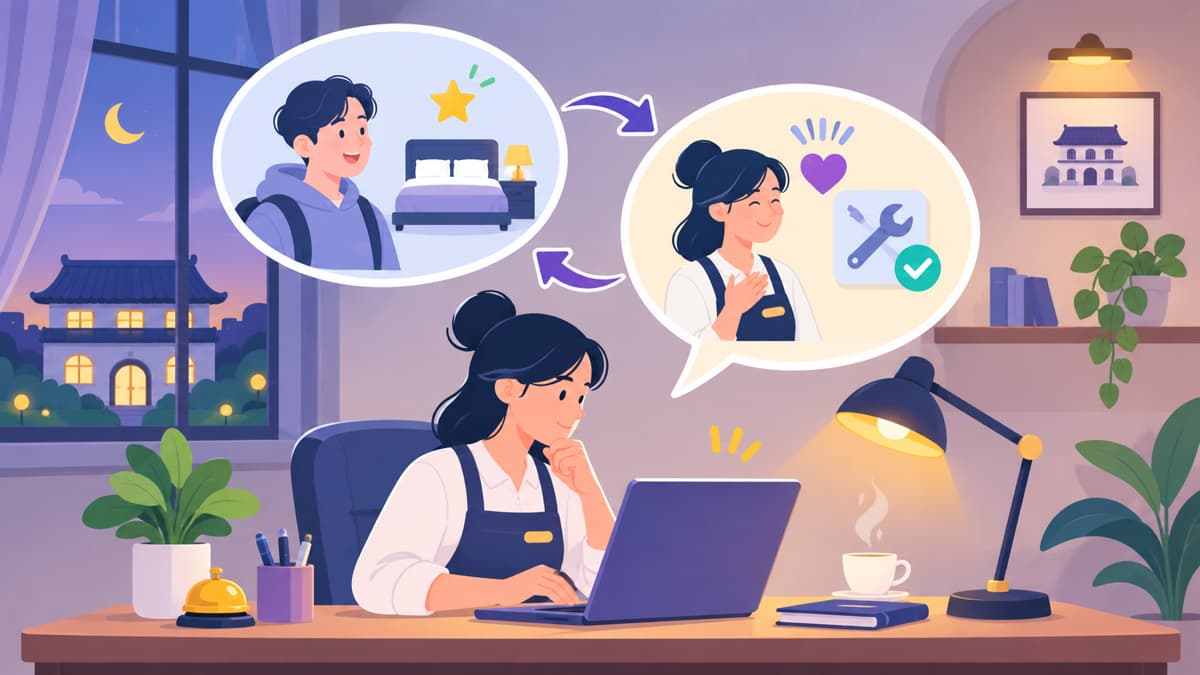
You have probably opened a review notification and then sat frozen in front of the reply box. For good reviews you end up repeating "Thank you, please visit again," and for reviews describing a problem, frustration gets ahead of you and you keep deleting and rewriting your sentences. A reply is read not only by the guest who wrote the review, but also by the next guests considering your property. Setting up a framework for each situation in advance greatly reduces the time and stress of writing replies.
💬 How to Structure a Reply to a Positive Review
Three elements are enough for a reply to a positive review: a thank-you, a mention of one specific moment from the review, and one piece of information that will be helpful on their next visit. Repeating a stock phrase unrelated to the review can actually come across as insincere.
On channels such as Tripbtoz, an OTA that expands listing exposure based on video reviews, reviews also serve as content that introduces the property, so the moments you highlight in your reply can help set expectations for the next guest. That said, reply features and how replies are displayed may differ by platform.
🩹 How to Structure a Reply to a Negative Review
Order is key. Write in this sequence: empathy and an apology for the inconvenience, specific acknowledgment of the points raised, the facts you confirmed or the action you took, and a brief closing. Even if some parts are inaccurate, don't lead with a rebuttal; calmly adding "From what we've confirmed" after the apology comes across more steadily to readers.
📋 Reply Framework Table
Situation | Key sentence elements | Phrases to avoid |
Complimentary review | Thanks + quote the moment mentioned + info for next visit | The same copy-pasted phrase on every review |
Facility or cleanliness complaint | Acknowledge the inconvenience + facts confirmed + corrective action | "Other guests had no problems" |
Structural limitations such as noise or location | Factual explanation + how to check before booking | Implying the guest should have known in advance |
Service complaint | Apology + shared internally + commitment to prevent recurrence | Blaming individual staff, excuses |
⚠️ What to Be Especially Careful About in Replies
Personal information: Do not include the guest's real name, room number, stay dates, companions, or contact details in your reply. Even if the reviewer has already mentioned them, it is safer not to repeat them in your reply. Relevant standards should be confirmed with a professional.
Promises of compensation: Don't leave promises like "Your next stay will be on us" in a public reply. It raises fairness issues with other guests, and compensation methods may be restricted by platform policy.
Asking for review removal: Requesting edits or deletion in a reply reads as pressure.
Your reply wording doesn't need to be perfect from the start.
Just jot down one framework for positive reviews and one for negative reviews, and adapt them to each situation. For the full review management workflow, continue with The Complete Guide to Accommodation Review Management: How Reviews Drive Bookings and a Routine to Manage Them.