


How to Recover When Your Rating Drops
When your rating drops, the first instinct is to collect positive reviews. But recovery is faster when you first figure out whether the drop is temporary or structural.
2026.11.09
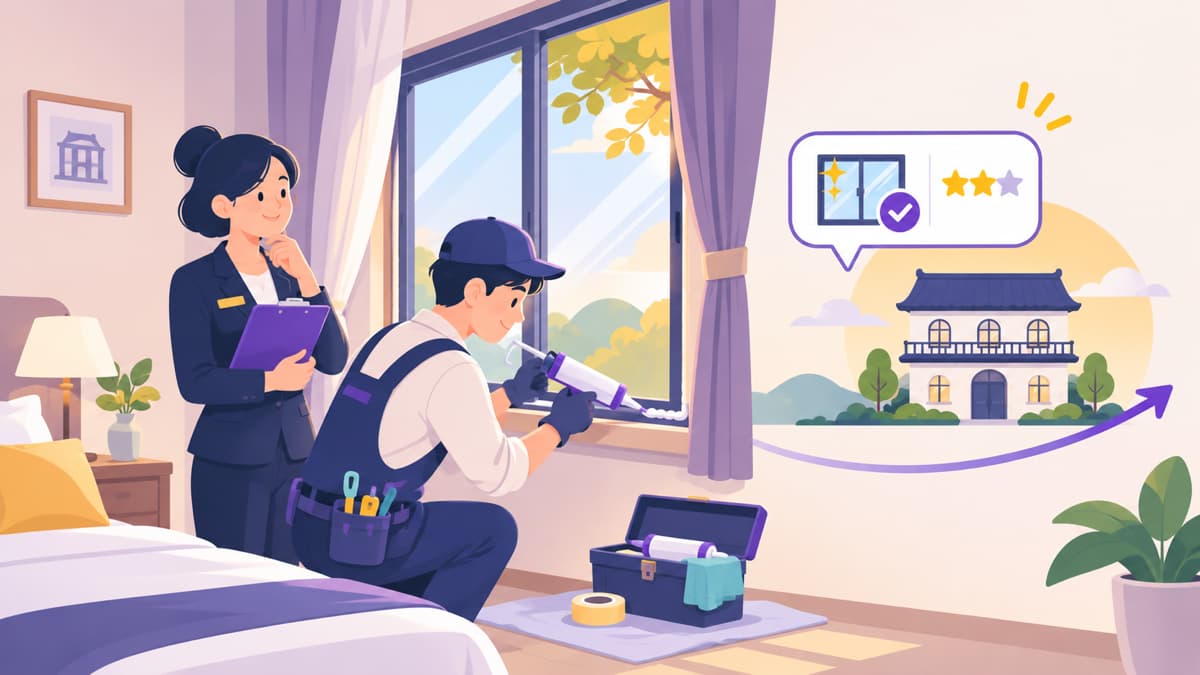
One day you notice your property's rating has dropped noticeably. When you open the reviews, complaints have piled up recently, and inquiries seem to have slowed. In a hurry, you may be tempted to ask friends for positive reviews, but the first thing to do is to identify what kind of drop it is.
🔎 Is the drop temporary or structural?
Type | Characteristics | How to check |
Temporary | Complaints cluster around a specific period or event, such as construction, fully booked peak season, or staff changes | Match the complaint dates against the rooms |
Structural | The same complaints, such as cleanliness, noise, or aging facilities, recur regardless of the period | Group review keywords to see whether they recur |
Mixed | A temporary event exposed a weakness that was already there | Check whether the same complaints continue after the event |
Rating calculation methods may differ by platform, so the impact of a single review also varies. It is safer to judge by the content of reviews rather than the score itself.
🔁 Recovery routine: fix the cause → strengthen responses → restart the flow of reviews
Fix the cause: Start with the recurring complaints and record the date of each improvement. For noise complaints, revisit how rooms are assigned; for cleanliness complaints, change the items on your inspection checklist.
Strengthen responses: Reply to existing complaint reviews with details of what you improved, and answer pre-check-in inquiries quickly. Rather than writing a long apology, state first what you changed.
Restart the flow of reviews: After the improvements, naturally invite actual guests to leave a review. On channels such as Tripbtoz, an OTA that expands listing exposure based on video reviews, the more recent reviews showing the improved room condition accumulate, the more easily the change comes across. However, how this is reflected may differ by platform.
⚠️ What to avoid while your rating is dropping
Action | Risk |
Getting friends or staff to write reviews | May look like manipulation and may violate platform policy |
Asking for positive reviews in exchange for discounts or rewards | May be sanctioned as incentivized reviews or cost you trust |
Rebutting negative reviews emotionally | Leaves an even worse impression on prospective guests |
Repeatedly requesting review removal without grounds | Requests may not be accepted. For false or malicious reviews, organize your evidence and follow the platform's procedure |
✅ Checklist
I have organized the date, room, and content of each complaint review
I have separated temporary and structural issues based on whether they recur
I have assigned a person in charge of each improvement and a completion date
I have replied to existing negative reviews with details of the improvements
I invite reviews without any reward conditions
I will check again whether the same complaints decrease in next month's reviews
A rating does not recover overnight, but if you fix the causes one by one and keep records, the direction becomes clear.
Start by picking one recurring complaint from this month's reviews. For the full picture, continue with The Complete Guide to Accommodation Review Management: How Reviews Drive Bookings and a Routine to Manage Them.