


Managing Motel Reviews on OTAs: How Low Ratings Affect Bookings and What to Do
There's something to look at before the rating itself. The phrases that keep repeating in your reviews show you exactly what to fix.
2026.10.19
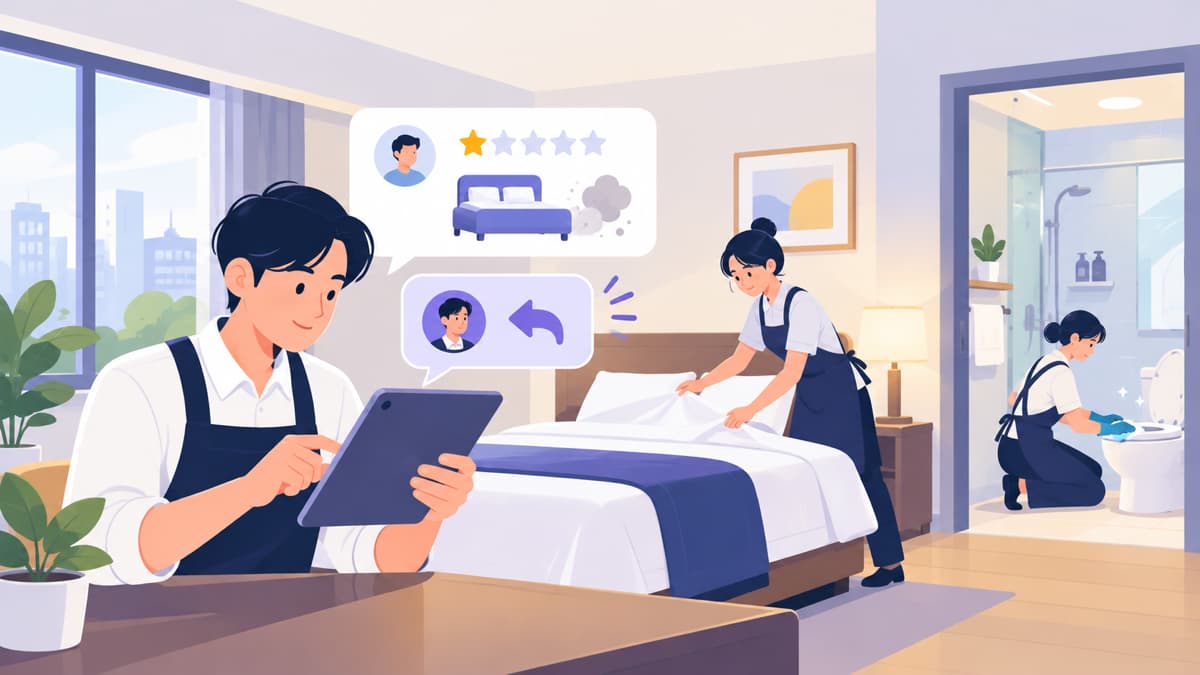
One morning, booking notifications are slower than usual. The rooms and rates haven't changed, but as you look for the reason, you notice the same comments overlapping in a few recent reviews: "The walls are thin," "Check-in took a long time." Guests read reviews before they ever see the room. Reviews are the voice that describes your property on your behalf when you, the owner, aren't there.
📊 How Ratings Influence Bookings
On OTAs, where guests compare many properties on a single screen, properties with low ratings are known to tend to drop off the shortlist first. Guests don't look only at the number. They also read the content of recent reviews, whether complaints lean in one direction, and whether the owner has replied. Many screen layouts make recent reviews more prominent, so the fact that your current operations are quickly reflected in reviews is both a burden and an opportunity. How ratings factor into search visibility may differ by platform, so rather than assuming, it is better to check each channel's guidelines.
🧭 Common Complaint Types in Motel Reviews
Rather than reading reviews one by one, group them by type and you'll see what needs fixing.
Type | Common Phrases in Reviews | First Response |
Cleanliness | Bedding, bathroom, odor | Introduce a room inspection checklist; assign someone to check after cleaning |
Noise | Next room, hallway, outside noise | Inform guests when assigning noise-sensitive rooms; improve soundproofing |
Check-in service | Waiting, unfriendliness, lack of information | Standardize service scripts; refine self check-in instructions |
Facilities | Heating/cooling, hot water, Wi-Fi | Set up a regular maintenance schedule |
Location/parking | Hard to find, not enough parking | Add directions photos and parking instructions |
💡 Principles for Replies and the Improvement Loop
Write replies not only for the guest who left a low rating, but also for the next guests who will read the reviews.
Keep it short, in this order: thanks, acknowledgment of the inconvenience, the fix you made, and an invitation to return.
Don't make excuses, argue back, or blame the guest.
Don't include personal information such as stay dates.
Reply to positive reviews too, to show your attitude toward guests.
Reply before too much time has passed.
For replies to negative reviews, this flow is enough: "We're sorry for the inconvenience; here is the cause we identified; here is what we changed; we hope you'll visit us again." Copying and pasting the same text is quickly obvious to readers, so write the cause and the fix differently for each review.
The improvement loop is simple: collect reviews, sort them by type, assign someone to take action, note the changes in your reply, and check whether the same comments disappear from the next reviews. If a review is factually inaccurate, first check the OTA's policy to see whether there is a deletion or dispute process. Whether this is possible, and the criteria, differ by platform.
On OTAs like Tripbtoz, which expand exposure based on video reviews, the way your room looks in the video effectively becomes the review. One approach is to put areas likely to appear on camera, such as bedding and bathrooms, at the top of your inspection checklist.
Review management is less about defending your rating and more about reading the signals that reveal gaps in your room operations.