


Hanokstay peak season and off-season rate strategy
If the rate is the same throughout the year, miss it during peak season and leave it empty during off-season. Start by dividing the timing.
2026.10.19
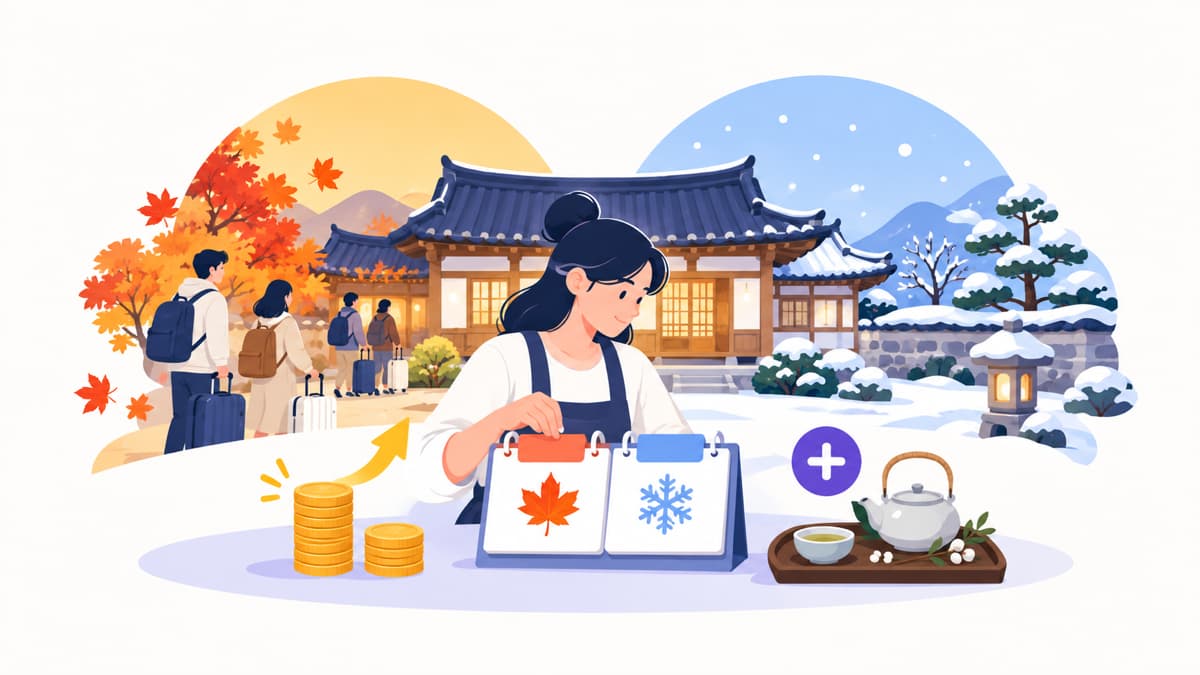
Inquiries line up during the fall foliage season, but the courtyard is quiet on weekdays in the middle of winter. Hanok Stay has few rooms, and demand varies greatly depending on the season, weather, and local events. If you use the same rate schedule throughout the year, you'll miss out on the rates you can get during the peak season and leave an empty room during the off-season. It's better to separate the fees by season.
🧭 Divide seasonal rates first
Before making a price list, let's mark the earliest time the room was cold and the longest time it was empty last year on a calendar. Even if you don't have an accurate number, it's easy to draw a dividing line if you just see the flow.
It is easier to make a decision if the period is divided broadly and only the direction of the fee is decided. The categories below are examples, and actual demand periods vary by region.
delimiting | Examples of this period | Price direction |
High season | Outing season, holiday season, local festival period | Review minimum stay settings that are higher than the standard rate |
Mid-peak season | Period around peak season | Maintain standard rates |
off-season | Heat/cold weather, weekdays | Adjust within a certain ratio compared to the base rate, set a lower limit |
The comfort level of a hanok, such as heating, air conditioning, and use of the courtyard, changes depending on the season. When setting off-season rates, consider this as well.
💰 Overnight stay, weekday discount, early bird, special price
Each method of discount aims for a different effect. Choose and write according to the purpose.
formulas | Expected effects | Points to note |
Long stay discount | Reduce empty days and reduce the number of cleanings and responses | The larger the discount, the lower the profit per night |
Weekday discount | Fill weekdays while keeping weekend rates | If the gap between weekdays and weekends passes, the weekend rate becomes less convincing |
Earlybird | Secure a room in advance during peak season and stabilize cash flow | Design change/cancellation rules together |
Last minute deals | Fill an impending empty room | If you operate all the time, trust in fixed prices is shaken |
If you open early bird and last-minute deals at the same time, customers who made a reservation first may be dissatisfied The application period for the two discounts is separated from the calendar. A mix of consecutive nights, weekday discounts, and last-minute specials are commonly used during the peak season, with a focus on early bird sales.
💡 Combine experiences during the off-season
There is also a way to add value instead of lowering fees. If you combine programs such as tea ceremonies, traditional crafts, and hanbok experiences with your stay, you can get away from comparing prices. In OTAs such as Tripbitos, which broaden exposure based on video reviews, experience scenes can be recorded as videos, so they are compatible with off-season products.
Have you secured the personnel and time frame to conduct the experience
Is there an alternative program for rainy days
Did you calculate the lowest price reflecting the cost of the experience
Have you decided on representative scenes to be shown in videos and photos
Are the cancellation and change rules for experience-inclusive products organized on the same basis as lodging
There are two types of experiences: they are included in the accommodation price or sold as optional options. It's less burdensome to start with options, see responses, and then expand to included products.
It's a good idea to set the price for a hanok stay based on the time when the appeal of the hotel is most evident.